Nobody had a single moment where they decided to let AI run their day. It just happened in increments — a thermostat that learned your schedule, a watch that started flagging your sleep patterns, an app that finished your sentences before you typed them. By 2026, artificial intelligence isn’t a feature you turn on anymore. It’s the quiet layer underneath most of the tools you already use.
This piece isn’t about the flashy AI headlines. It’s about the routine stuff — the parts of your morning, workday, and evening where AI is doing more than most people realize, where it’s genuinely useful, and where it’s still overpromising.
Your Home Is Already Making Decisions Before You Ask
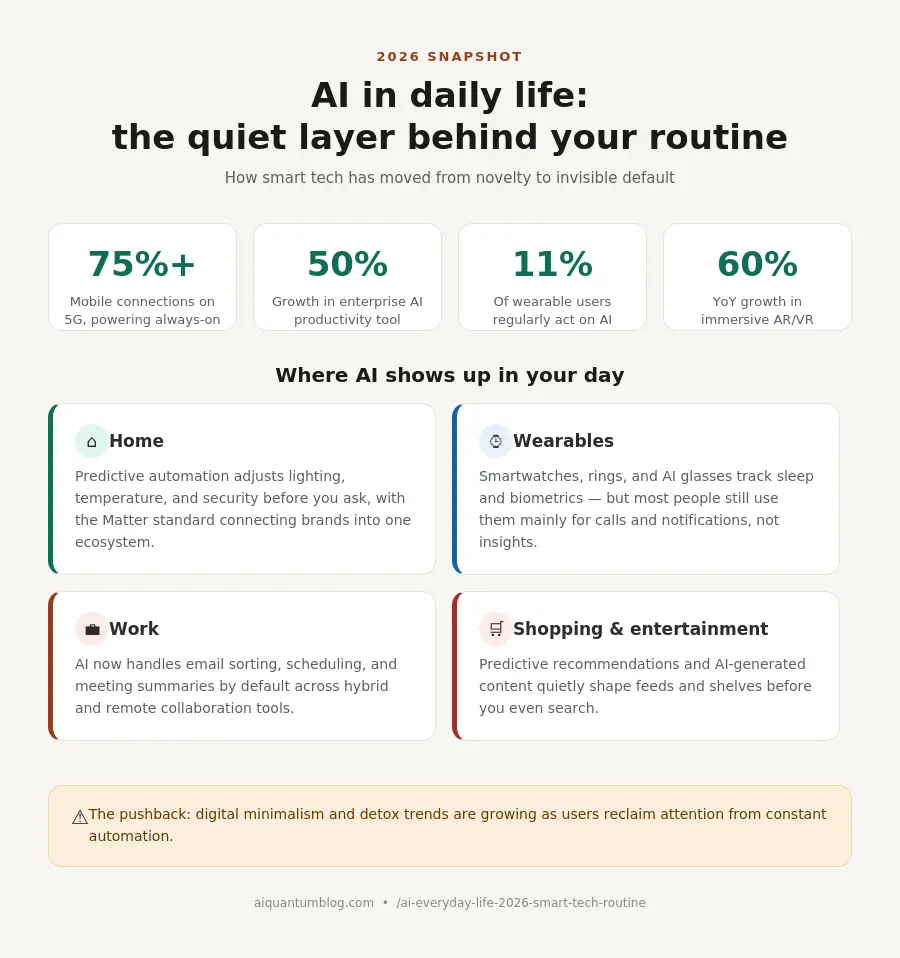
Smart home technology moved from reactive to predictive in the past year. AI-powered predictive home automation now learns user habits and automates tasks based on daily routines — adjusting lighting, temperature, and security settings by analyzing behavior patterns rather than waiting for a voice command. The practical result: many households now use AI assistants to manage energy, security, and entertainment without anyone explicitly programming a schedule.
Two things are driving this beyond the AI itself. First, the Matter standard is being adopted widely enough that devices from different brands can finally talk to each other, which used to be the biggest friction point in smart homes. Second, generative AI voice assistants are getting better at understanding tone and intent, not just fixed commands — so ‘it’s a bit cold in here’ now works the same as ‘set the thermostat to 71.’
Wearables Have Quietly Become Health Companions
Wearable technology has moved well past step-counting. In 2026, smartwatches, smart rings, and AI-powered health trackers are functioning as genuine health companions, using improved sensors and longer battery life to monitor sleep, recovery, and biometric trends continuously in the background.
But there’s a real gap worth naming here: while AI-powered features are increasingly common across wearable platforms, actual usage is limited. Just 11% of users say they regularly seek out personalized AI-driven insights or recommendations, and 38% mainly use their wearables for calls, texts, and notifications — far more basic functionality. In other words, the AI capability has outpaced how people actually use it. Devices that explain how a conclusion was reached, instead of just presenting a recommendation, are seeing better engagement, because trust matters more than feature count.
Smart glasses are the newest quiet entrant
Devices like Even Realities G2 and Ray-Ban Meta smart glasses reflect a deliberate shift toward invisible, lifestyle-first AI — assistance delivered through voice and lightweight prompts rather than another screen demanding attention. That design philosophy, more than any single feature, is what’s defining this wearable generation.
AI Is Running Your Workday Whether You Notice It or Not
Enterprise adoption of AI-driven productivity tools grew roughly 50% as remote and hybrid teams leaned on AI-powered collaboration tools to streamline workflows. In practice, that means AI is now handling email organization, scheduling, meeting summaries, and reminders as a default layer of office software rather than an optional add-on — quietly absorbing the small administrative decisions that used to eat up a working day.
Shopping, Streaming, and Everyday Spending Are Being Shaped by AI Too
E-commerce platforms now lean on AI-driven recommendations, predictive logistics, and hyper-personalized shopping experiences, tailoring what you see before you’ve searched for it. On the entertainment side, immersive AR and VR usage grew roughly 60% year over year, with AI-generated content and interactive platforms increasingly shaping what shows up in your feed and how it’s delivered.
The Pushback: Digital Minimalism Is Growing Alongside AI Adoption
Not everyone is opting in quietly. Digital detox and minimalism trends are gaining real momentum in 2026, as more people intentionally reduce digital clutter and screen time to protect focus and mental health. This isn’t a rejection of AI outright — it’s a growing awareness that convenience and attention are a trade-off, and some users are actively pushing back on how much of their routine has been automated without a clear decision point.
Where AI in Daily Life Still Falls Short
- Insight-to-action gap: Many AI features generate data and recommendations that feel disconnected from what the user actually needs, which is why real adoption often lags far behind technical capability.
- Privacy concerns remain unresolved: Continuous monitoring through wearables and smart home devices raises real questions about who has access to biometric and behavioral data, and manufacturers are still catching up on transparency.
- Trust is inconsistent: Users are more willing to act on AI recommendations when the system explains its reasoning rather than just outputting a suggestion — a UX problem, not a technical one, and most platforms haven’t solved it yet.
- Interoperability is still incomplete: Even with standards like Matter gaining traction, getting every device in a household or workflow to genuinely work together remains more effort than most people expect.
- Notification fatigue: The same AI systems designed to reduce friction can just as easily add another layer of alerts, dashboards, and prompts competing for attention.
What Should You Actually Do With This?
If you’re evaluating a smart home setup, prioritize devices that support cross-brand standards like Matter rather than locking into a single ecosystem. If you’re choosing a wearable, look past the feature list and ask whether it explains its recommendations clearly — that’s the difference between a device you’ll actually use and one that ends up in a drawer. And if your day already feels quietly run by AI tools you didn’t consciously choose, an honest audit of what’s actually adding value versus what’s just adding noise is worth the hour it takes.
Frequently Asked Questions
How much of daily life is actually run by AI in 2026?
More than most people realize but less than headlines suggest. AI is deeply embedded in smart home automation, wearable health tracking, workplace productivity tools, and shopping recommendations — but actual engagement with AI-specific features, like personalized wearable insights, remains surprisingly low even where the technology is available.
Are AI-powered wearables actually accurate for health tracking?
They’re improving, particularly for sleep trend detection and biometric monitoring, but the most reliable systems still function more like screening tools than medical-grade diagnostics. They’re best used to spot patterns over time, not as a replacement for professional health assessment.
What’s driving the growth of smart home AI in 2026?
Two factors mainly: predictive automation that learns household routines instead of waiting for commands, and the growing adoption of the Matter standard, which lets devices from different manufacturers work together instead of requiring a single-brand ecosystem.
Why are people pushing back against AI in their daily routines?
Digital minimalism and digital detox trends are growing because constant automation and monitoring can come at the cost of attention and mental health. It’s less a rejection of AI and more a demand for intentional control over how much of a routine gets automated by default.
Is AI smart glasses the next big wearable category?
It’s one of the fastest-growing ones. The appeal isn’t more screens — it’s the opposite: lightweight, fashion-conscious devices that deliver AI assistance through voice and subtle prompts, fitting into daily life instead of demanding attention like a phone or smartwatch does.
The Bottom Line
AI didn’t take over daily routines with a dramatic announcement. It arrived through better thermostats, quieter wearables, faster inboxes, and shopping feeds that started feeling a little too accurate. Some of that is genuinely useful. Some of it is convenience dressed up as necessity. The people getting the most value in 2026 aren’t the ones with the most AI-powered devices — they’re the ones who know which parts of their routine are actually better for it, and which parts they’ve just stopped questioning.