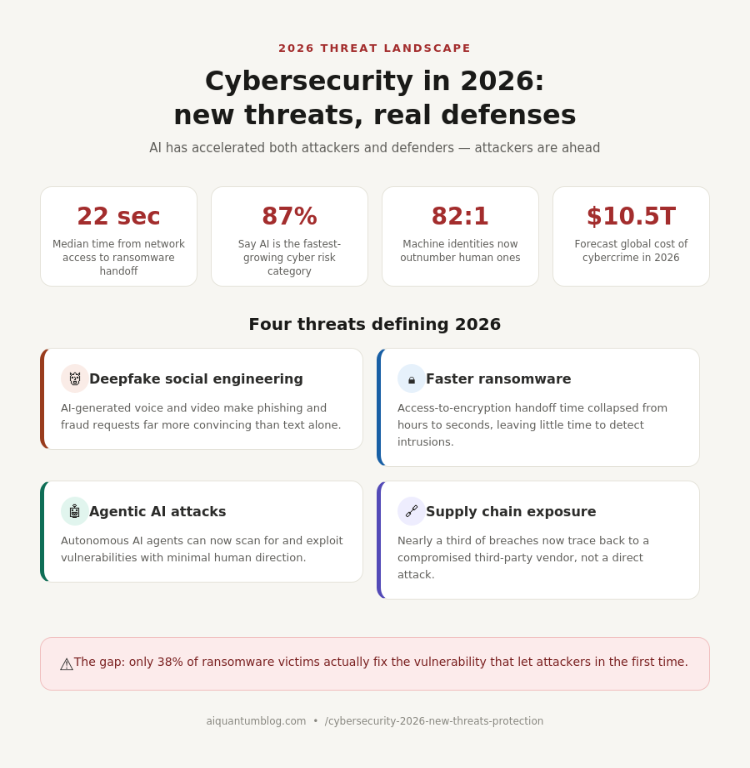
Cybersecurity used to be a race between attackers and defenders running at roughly the same speed. That’s no longer true. In 2026, AI has accelerated both sides at once — but attackers are moving faster. Access-to-ransomware handoff times that used to take hours now take seconds. Deepfake voices are convincing enough to authorize wire transfers. And the total cost of cybercrime is forecast to surpass $10.5 trillion this year alone.
This isn’t a scare piece. It’s a clear-eyed look at what’s actually changed, which threats deserve real attention right now, and what defenses genuinely hold up against them — for individuals and for the organizations everyone works inside of.
The Threat Landscape Has a New Engine: AI
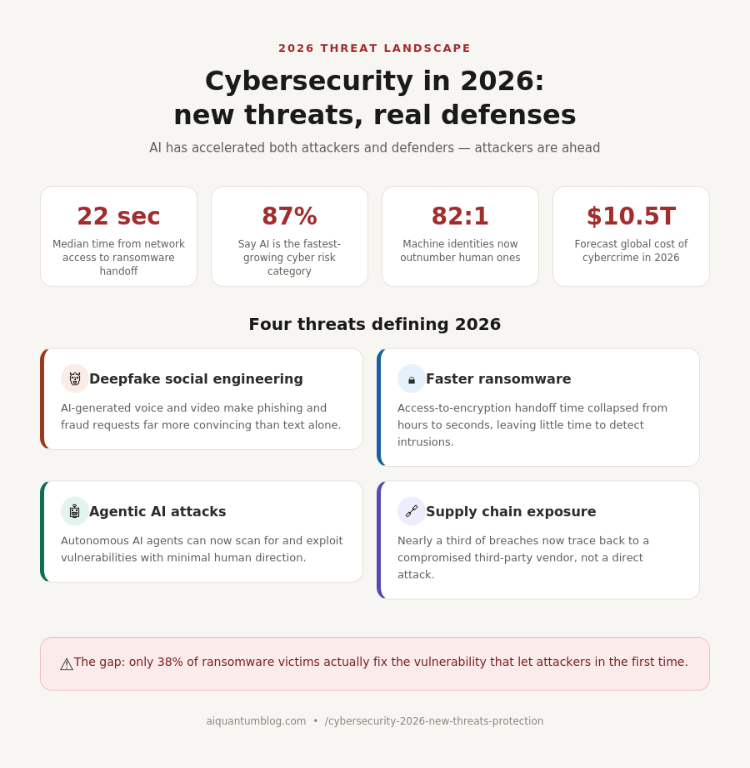
The single biggest shift in 2026 isn’t a new type of attack — it’s a new accelerant behind familiar ones. The World Economic Forum found that 87% of security professionals now identify AI-related vulnerabilities as the fastest-growing cyber risk, and separately, 85% of organizations say AI-powered threats are making traditional defenses obsolete. That’s not hyperbole from vendors trying to sell tools; it reflects a real capability shift on the attacker’s side.
Deepfakes have moved from novelty to core attack vector
Nearly nine in ten organizations (87%) say AI-generated methods such as deepfakes are making phishing attempts more convincing, and the FBI’s Internet Crime Complaint Center recorded more than 22,000 AI-related complaints with over $893 million in adjusted losses in a single year. Deepfake-as-a-Service is emerging as a real category, making high-level social engineering and identity fraud accessible to attackers who previously lacked the technical skill to pull it off.
Autonomous, agentic attacks are the next escalation
By 2026, the threat landscape increasingly includes agentic AI-driven attacks — autonomous systems that can identify and exploit vulnerabilities in real time with minimal human direction. That changes the economics of an attack: instead of a human attacker manually probing for weaknesses, an AI agent can scan, adapt, and strike continuously.
Ransomware Got Faster, Not Just Bigger
Ransomware isn’t a new threat, but its speed has changed dramatically. The median handoff time between an initial access broker gaining entry and a ransomware operator taking over collapsed to just 22 seconds in 2025 — down from more than 8 hours in 2022. That compression means the window for detecting and stopping an intrusion before it becomes a full ransomware event has essentially disappeared for organizations relying on manual response.
The scale is climbing too: publicly disclosed ransomware victims rose 213% year-over-year in early comparisons, and around 77% of ransomware intrusions now involve data exfiltration alongside encryption — meaning a ransomware event is almost always a data breach as well. Triple extortion, which layers a third pressure tactic (often contacting the victim’s customers or partners directly) on top of encryption and data theft, is becoming a defined trend rather than an edge case.
Despite all this, fewer than one in four ransomware victims (38%) actually fixed the vulnerability that allowed the attack in the first place — meaning a significant share of organizations remain exposed to the exact same entry point after paying to recover from it.
Phishing Remains the Front Door — It’s Just Better Disguised Now
Phishing hasn’t been replaced by more sophisticated attacks; it’s been upgraded by them. About seven in ten organizations expect a phishing attack in 2026, and phishing emails increased 17.3% in a recent six-month comparison period, with over 11% of those attacks sent from already-compromised, trusted accounts within an organization’s own supply chain — meaning the email genuinely comes from a partner’s real account, not a spoofed one.
Roughly 56% of businesses have already experienced phishing attacks, and it remains more common than viruses, malware, or business email compromise combined in year-over-year comparisons. The technique is old. What’s changed is how convincing the bait has become.
Identity Is Becoming the New Perimeter
One of the quieter but more significant shifts in 2026 is around machine identities — the credentials used by bots, APIs, and AI agents rather than humans. Machine identities now outnumber human identities by roughly 82 to 1 inside the average organization, and AI systems are now the leading creator of new identities with privileged, sensitive access. That’s a fundamentally different attack surface than the one most security teams were built to defend a few years ago.
This is a major reason Zero Trust Network Access is becoming the preferred remote access model in 2026, replacing legacy VPNs as they reach end-of-life — a Zero Trust approach verifies every request regardless of source, rather than assuming anything inside the network perimeter is automatically trustworthy.
Who’s Actually Being Targeted
- Critical manufacturing: network denial-of-service is now the second-most common attack method after data manipulation, disrupting physical operations, not just IT systems.
- Healthcare and finance: ransomware activity is increasingly concentrated on these sectors specifically, where the pressure to restore operations quickly makes ransom payment more likely.
- Education: the sector is seeing a 6% increase in ransomware attacks, often due to under-resourced IT security teams relative to the sensitive data they hold.
- Supply chains: at least 29% of all data breaches now involve a third-party vendor rather than a direct attack on the target organization itself.
- High-growth regions: weekly cyberattacks in India have reportedly reached 3,195 per organization in early 2026, 62% higher than the global average — a signal that attacker attention is following digital growth, not just wealth.
What Actually Works: Defenses Worth Prioritizing in 2026
Not every defense claim holds up under the current threat pattern. Based on what’s actually reducing risk in 2026, a few priorities stand out clearly above the noise:
- Zero Trust architecture: continuous verification of every access request, rather than one-time perimeter authentication, directly counters the 22-second ransomware handoff problem by removing the assumption of implicit trust.
- AI-driven threat detection: ironically, the same technology powering new attacks is the most effective tool against them — AI-driven detection and automated incident response are the top two ways small and mid-sized businesses plan to use AI defensively in 2026.
- Patch the root cause, not just the symptom: given that only 38% of ransomware victims actually fix the vulnerability that let attackers in, closing the specific entry point after an incident is one of the highest-value, most-skipped steps in recovery.
- Third-party risk management: since nearly a third of breaches trace back to a vendor or supply-chain partner, vetting and monitoring third-party access is no longer optional due diligence — it’s a primary attack surface.
- Deepfake-aware verification protocols: for any high-stakes request (wire transfers, credential resets, executive instructions), a secondary verification channel that doesn’t rely on voice or video alone is now a baseline precaution, not paranoia.
What Should You Actually Do With This?
If you run a business, start with identity: audit how many machine identities (bots, APIs, AI agents) have privileged access in your systems, since that’s the attack surface growing fastest and receiving the least attention. If you’re an individual, treat any urgent request involving money or credentials — especially one that arrives by voice or video — with a second, independent verification step before acting, since deepfake-enabled social engineering is specifically designed to create urgency that skips that step. And if your organization has experienced a ransomware incident before, confirm the root vulnerability was actually patched — the data suggests it often isn’t.
Frequently Asked Questions
Is AI actually making cyberattacks worse, or is that overstated?
It’s a genuine shift, not just marketing language. The overwhelming majority of security professionals (87%) now rank AI-related vulnerabilities as the fastest-growing risk category, and concrete metrics — like ransomware handoff times collapsing from hours to seconds — show the acceleration is measurable, not theoretical.
What is a deepfake attack and how common is it in 2026?
A deepfake attack uses AI-generated audio or video to impersonate a real person — often an executive or trusted contact — to authorize a fraudulent action like a wire transfer or credential reset. Nearly 87% of organizations report that deepfakes are making phishing and social engineering attempts more convincing, and it’s now recognized as one of the threats security leaders feel least prepared for.
Are legacy VPNs still safe to use for remote access?
They’re increasingly considered inadequate. Zero Trust Network Access is becoming the preferred model in 2026 specifically because legacy VPNs assume too much implicit trust once a user is inside the network, which doesn’t hold up against the speed and sophistication of current attacks.
Why do ransomware attacks keep happening to the same organizations?
Largely because the root vulnerability often doesn’t get fixed. Fewer than one in four ransomware victims actually patch the specific weakness that allowed the original attack, leaving the same entry point open for a repeat incident.
What’s the single most effective thing a small business can do right now?
Prioritize AI-driven threat detection and phishing defense — these are the top two ways small and mid-sized businesses are already deploying AI defensively in 2026, and phishing remains the most common attack vector by a wide margin.
The Bottom Line
Cybersecurity in 2026 isn’t defined by one dramatic new threat — it’s defined by speed. AI has compressed the time between intrusion and impact, made social engineering harder to detect by ear or eye, and shifted the attack surface toward machine identities most organizations aren’t yet watching closely. The defenses that work aren’t exotic either: Zero Trust, AI-assisted detection, closing the vulnerabilities that already got exploited once, and a healthy skepticism toward urgent requests. The organizations doing well in 2026 aren’t the ones with the most security tools — they’re the ones treating identity and verification as seriously as attackers already do.
Want to stay ahead of the threats reshaping cybersecurity? Subscribe for updates as new attack patterns and defenses emerge — or share this with a colleague who still thinks a strong password is enough.