The smartphone hasn’t had a genuinely new idea in years. Cameras got more megapixels, chips got faster, screens got bigger — the same phone, iterated. That streak is ending. In 2026, several separate technologies are maturing at the same time: on-device AI chips, crease-free foldable displays, silicon-carbon batteries, and early 6G testing. None of them alone is dramatic. Together, they’re the foundation of a genuinely different device over the next decade.
This isn’t a spec-sheet roundup. It’s a look at which of these shifts are real and shipping, which are still marketing ahead of substance, and what they add up to for how you’ll actually use a phone by the mid-2030s.
On-Device AI Is Turning Phones Into Personal Assistants, Not Just Tools
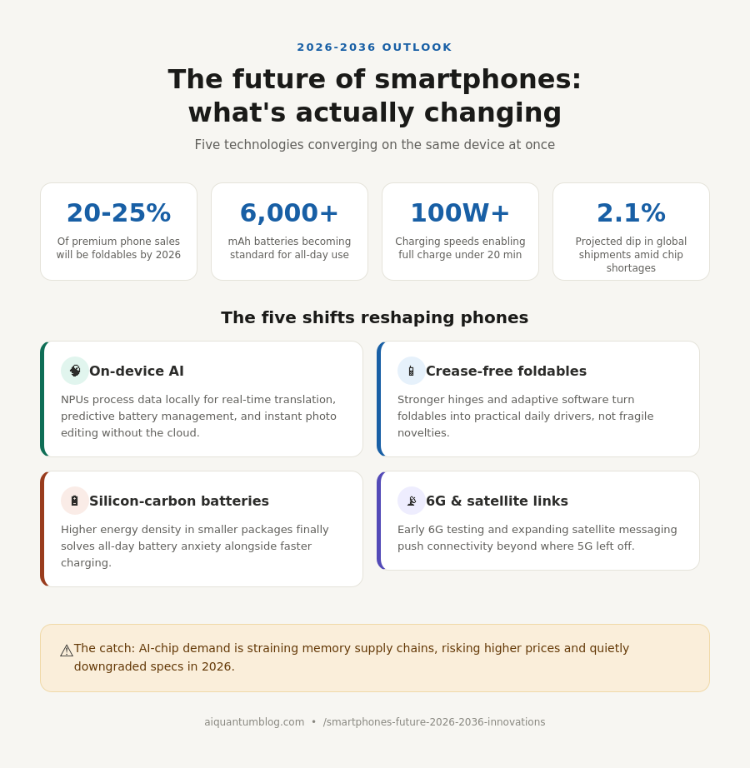
The biggest shift in 2026 isn’t a new AI feature — it’s where the AI runs. Advanced neural processing units from Qualcomm and Apple now handle complex computations locally on the device rather than sending them to the cloud, which cuts latency and meaningfully improves battery efficiency. That’s not a minor technical detail: it’s what makes real-time translation, predictive battery management, and instant photo editing feel instantaneous instead of laggy.
On-device processing also has a privacy angle that’s shaping where this trend lands hardest. In markets with strict data regulations like the US and EU, on-device AI is becoming the default expectation rather than a premium feature, since it lets sensitive data stay on the phone instead of round-tripping through a server.
The practical result by 2026: AI assistants capable of real-time translation, task automation, and scheduling, AI-powered photography that handles background editing and scene recognition automatically, and predictive systems that anticipate what you need before you ask. The phone is shifting from a tool you operate to something closer to a companion that operates alongside you.
Foldables Are Finally Becoming Practical, Not Just Impressive
Foldable phones spent their first few years as a proof of concept — expensive, crease-prone, and fragile. That’s changing fast. By 2026, foldables are projected to account for roughly 20 to 25% of premium smartphone sales, and the reasons are concrete: enhanced hinge mechanisms are reducing the visible crease that plagued earlier models, and larger foldable batteries now support genuine all-day use instead of requiring a midday top-up.
Apple’s widely rumored entry into foldables is expected to be the tipping point for mainstream adoption — the same effect the original Apple Watch had on legitimizing smartwatches as a category. Samsung’s continued refinement of the Z Fold series and devices like the Honor Magic V3, which proves foldables can now be as thin and light as conventional phones, are already showing what that mainstream version looks like.
What foldables actually enable, beyond a bigger screen
The interesting part isn’t screen size — it’s adaptive multitasking. Crease-free OLED panels paired with adaptive software let you run a video call on one screen while editing a document on another, turning a phone into something closer to a pocket tablet without sacrificing portability when folded.
Batteries and Charging Are Solving the Two Oldest Smartphone Complaints
Battery anxiety and slow charging have been the most persistent smartphone frustrations for over a decade, and 2026 is the year the hardware genuinely catches up. Silicon-carbon batteries are delivering higher energy density in smaller packages, enabling the shift toward 6,000mAh-plus batteries that provide real all-day battery life even under heavy use — not just on a spec sheet, but in practice.
Charging speed is improving in parallel: speeds exceeding 100W now mean a full charge in under 20 minutes for some devices. Combined with AI-driven predictive battery management that learns your usage patterns and adjusts power draw accordingly, the two most-complained-about aspects of smartphone ownership are being addressed at the same time.
Cameras Are Getting Smarter, Not Just Higher-Resolution
Camera technology has quietly moved past the megapixel arms race. In 2026, computational photography — combining multiple exposures, AI scene recognition, and advanced image processing — is doing more for photo quality than sensor size alone ever could. The result is cameras that make smarter decisions about a shot in the moment, rather than just capturing more raw pixels for editing afterward.
Connectivity Is Already Looking Past 5G
5G is now the established baseline, but early 6G testing is underway, with some forecasts suggesting early commercial 6G-compatible devices could appear as soon as late 2026 — promising lightning-fast cloud access, ultra-HD streaming, and latency low enough to theoretically support things like complex remote surgery. Satellite connectivity is expanding too: what started as emergency-only messaging in 2025 is broadening toward two-way texting and calling in remote areas with no mobile network at all, with support spreading across both Android and iOS devices.
The Part Nobody’s Advertising: Rising Prices and Supply Constraints
It’s worth being direct about the tension underneath all this innovation: a pivot toward AI-focused chip manufacturing is straining memory and component supply chains. Some analysts are warning that 2026 could bring downgraded configurations at the same price points — flagship RAM dropping from 16GB to 12GB, budget models reverting to 4GB — alongside a projected 2.1% decline in global shipments. For consumers, that means the shiny new capabilities above may come bundled with higher prices or quietly reduced specs elsewhere in the device.
There’s also a sustainability thread worth naming: modular designs that let users replace batteries or cameras without replacing the entire phone are gaining traction as more brands lean into eco-conscious manufacturing — a meaningful shift after years of phones being built to be replaced rather than repaired.
What This Actually Means for the Next Decade
None of these innovations are revolutionary in isolation. A better NPU, a sturdier hinge, a denser battery — each is an incremental engineering win. What makes this decade different is that they’re converging on the same devices at the same time. A foldable phone with an advanced on-device AI processor and a silicon-carbon battery creates genuinely new use cases that weren’t possible when these technologies existed separately. That convergence, more than any single feature, is what the next decade of smartphones is actually about.
What Should You Actually Do With This?
If you’re due for an upgrade, on-device AI capability and battery technology are the two specs worth prioritizing right now — both are far more mature and reliable in 2026 than they were even a year ago. If you’ve been curious about foldables but held off over durability concerns, the current generation of hinge mechanisms addresses the complaint that mattered most. And if you’re budget-conscious, buy sooner rather than later this year: supply chain pressure on memory chips is a real near-term risk to both pricing and specs, not a hypothetical one.
Frequently Asked Questions
Are foldable phones actually reliable now, or still fragile?
Meaningfully more reliable than early models. Enhanced hinge mechanisms have reduced the crease and durability issues that defined the first generation of foldables, and devices like the Honor Magic V3 show foldables can now match conventional phones in thinness and weight.
What’s the difference between on-device AI and cloud-based AI on a phone?
On-device AI processes data locally using the phone’s own NPU, which is faster and keeps sensitive data on the device rather than sending it to a server. Cloud-based AI relies on remote servers, which can be more powerful for complex tasks but introduces latency and privacy trade-offs that on-device processing avoids.
Will 6G actually be available on phones in 2026?
Only in early, limited form. Testing is underway and some forecasts point to early commercial 6G-compatible devices appearing by late 2026, but widespread 6G network coverage and mainstream adoption remain further out — 5G is still the practical baseline for nearly all users this year.
Why might smartphone prices rise in 2026 despite better technology?
A supply chain shift toward AI-focused chip manufacturing is creating memory shortages, which some analysts warn could push flagship prices higher or force manufacturers to quietly reduce specs like RAM at the same price point.
What should I actually look for when buying a phone in 2026?
Prioritize on-device AI capability, battery capacity paired with fast-charging support, and — if you want a device built to last — modular repairability features, since these represent the most mature and genuinely useful innovations this year, rather than early-stage technology still working out its kinks.
The Bottom Line
The smartphone isn’t being reinvented with one big leap — it’s being rebuilt through several mature technologies landing on the same devices at once. On-device AI, durable foldables, denser batteries, smarter cameras, and early 6G aren’t isolated upgrades anymore; they’re converging into a genuinely different kind of device. The next decade of smartphones won’t be defined by a single breakthrough feature. It’ll be defined by how naturally these pieces start working together.