The 2026 shift away from stark, all-white minimalism — and how to keep the calm without losing the warmth.
Minimalism used to mean bare walls, cold grays, and rooms that photographed well but never felt lived-in. That version of minimalism is fading. In its place, designers are describing 2026 interiors with a new term: warm minimalism — the same uncluttered structure, but built from natural materials, earthy color, and a few meaningful objects instead of empty corners. Here’s how to actually design that balance in your own home, room by room.
Why “Cold” Minimalism Stopped Working for Most Homes
Ask anyone who tried the all-white, ultra-minimal look why they eventually gave it up, and the answers repeat:
- Rooms felt sterile and hard to relax in, more like a showroom than a home.
- Constant decluttering felt like a chore instead of a lifestyle.
- Guests described the space as “nice, but cold.”
- Neutral-on-neutral palettes photographed well but felt flat in person.
- There was no visible personality — no sense of who actually lived there.
Warm minimalism solves this by keeping minimalism’s real value — fewer, better things — while adding back texture, warmth, and personal meaning.
1. Start With an Edit, Not a Shopping List
The instinct when a room feels off is to buy something new. In warm minimalism, the first move is the opposite: remove what you don’t use, love, or need. Clear surfaces are still the foundation — the difference is what stays.
A simple three-question edit
- Have I used or worn this in the last year?
- Does it have meaning, or is it just filling space?
- If I saw this in a store today, would I buy it again?
Anything that fails all three questions can go. What’s left becomes the foundation you build the cozier layers on top of.
2. Choose Natural, Tactile Materials Over Synthetic Ones
This is the biggest material shift defining 2026 interiors. Light oak flooring, unlacquered brass hardware, limewash-painted walls, and raw linen upholstery are replacing high-gloss, synthetic finishes. These materials age visibly over time — brass darkens, linen softens, wood develops grain character — and that visible aging is part of the appeal, not a flaw to avoid.
- Swap a laminate coffee table for a solid wood or reclaimed-wood piece.
- Replace chrome cabinet hardware with unlacquered or brushed brass.
- Choose a linen or boucle sofa cover instead of a synthetic-blend fabric.
3. Build an Earthy, Warm Color Palette
Stark white and cool gray are giving way to clay, olive, chocolate brown, and warm terracotta as base tones for 2026 interiors. The goal isn’t to abandon neutrals — it’s to warm them up.
- Base neutral: warm white, greige, or soft oat instead of stark white or cool gray.
- Anchor tone: one earthy color per room — olive green, rust, or clay works in most spaces.
- Accent: a single deeper tone (chocolate brown, forest green) used sparingly in textiles or trim.
This three-tone structure keeps the palette intentional instead of chaotic — which is what keeps a warm-minimalist room from tipping into clutter.
4. Layer Textures the Way You’d Layer Clothing
Texture is what makes a minimal room feel warm instead of empty. Designers describe this as layering the way you’d layer an outfit for winter — a base, a mid-layer, and a finishing texture on top.
- Base layer: a natural-fiber rug (jute, wool, or a low-pile weave) grounds the room.
- Mid layer: linen or boucle upholstery on the main seating piece.
- Top layer: a chunky knit throw, a few textured pillows, or a woven wall hanging.
Two or three textures per room is usually the sweet spot — more than that starts to compete rather than complement.
5. Keep Only a Few Meaningful Objects — But Let Them Show
In cold minimalism, personal items were often hidden away to preserve the clean look. Warm minimalism does the opposite: it puts a handful of meaningful, collected pieces on open display — a piece of pottery from a trip, an inherited mirror, a hand-thrown vase — instead of generic matching decor.
- Choose one “anchor” object per room that has a real story attached to it.
- Avoid matching decor sets — mismatched, collected pieces read as more intentional, not less.
- Leave breathing room around each object instead of clustering many small items together.
The Warm Minimalism Formula at a Glance
The infographic below breaks the approach into five layers you can apply to any room, in order.
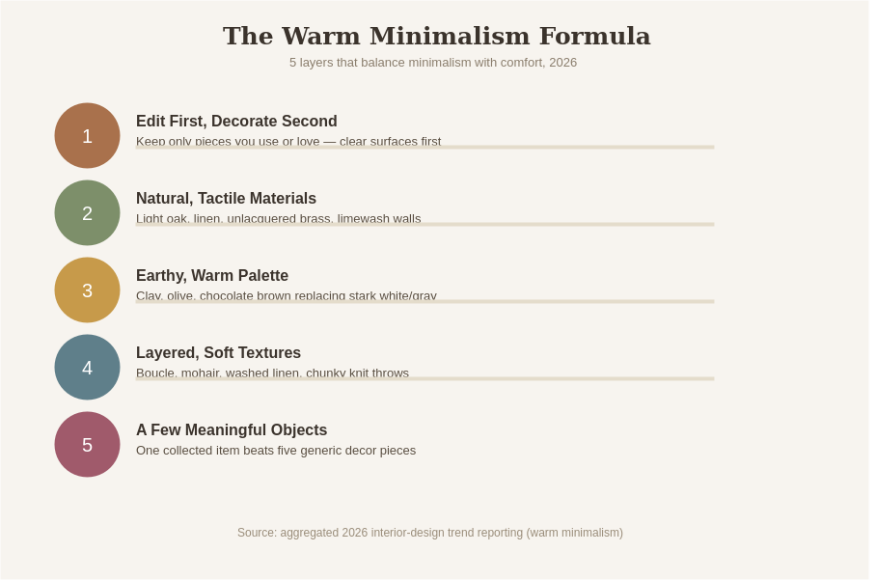
Ready to try it? Start with the edit step in one room this week — warm minimalism works best built one layer at a time, not all at once.
Room-by-Room: Where Warm Minimalism Works Best
- Bedroom — the “cocoon” approach: upholstered headboard, washed linen bedding, warm low lighting.
- Living room — natural-fiber rug plus one collected object on the coffee table or shelf.
- Kitchen — unlacquered brass fixtures and open shelving with a few well-used, good-looking pieces.
- Bathroom — limewash or lime-plaster-effect walls with a single wood or stone accent.
Common Mistakes That Break the Balance
- Going too cold: an all-neutral room with no texture just becomes the old minimalism again.
- Going too busy: too many collected objects at once reads as clutter, not curation.
- Mixing too many wood tones or metal finishes in one room without a unifying warm undertone.
- Skipping the edit step and layering warmth on top of a still-cluttered room.
Want our free room-by-room warm minimalism checklist? Subscribe below and we’ll send it to your inbox along with our next design breakdown.
Frequently Asked Questions
What’s the difference between minimalism and warm minimalism?
Traditional minimalism prioritizes bare, uncluttered spaces, often in stark white or cool gray. Warm minimalism keeps the same uncluttered structure but replaces cold tones and synthetic finishes with natural materials, earthy color, and a few meaningful, visible objects.
Is warm minimalism expensive to achieve?
Not necessarily. The core moves — editing down what you own, choosing a warmer paint tone, and adding one or two natural-fiber textiles — cost far less than a full furniture overhaul. The natural-materials swaps (like solid wood or brass) can be done gradually as pieces need replacing.
How many colors should a warm minimalist room have?
Most designers recommend a three-tone structure: one warm neutral base, one earthy anchor color, and a single deeper accent used sparingly. More than three main tones tends to undercut the calm, edited feeling the style is built around.
Can warm minimalism work in a small apartment?
Yes — arguably it works especially well in small spaces, since the emphasis on editing and fewer, better pieces naturally suits limited square footage. Focus on one anchor textile (a rug) and one anchor object per room rather than filling every surface.
What materials define the warm minimalism trend in 2026?
Light oak flooring, unlacquered brass hardware, limewash-painted walls, washed linen, boucle, and mohair upholstery are the materials most associated with the 2026 warm minimalism trend, all chosen for how naturally they age over time.
Warm minimalism isn’t a rejection of minimalism — it’s a more livable version of it. Keep the discipline of owning less, but let what you keep be warm, textured, and genuinely yours.